


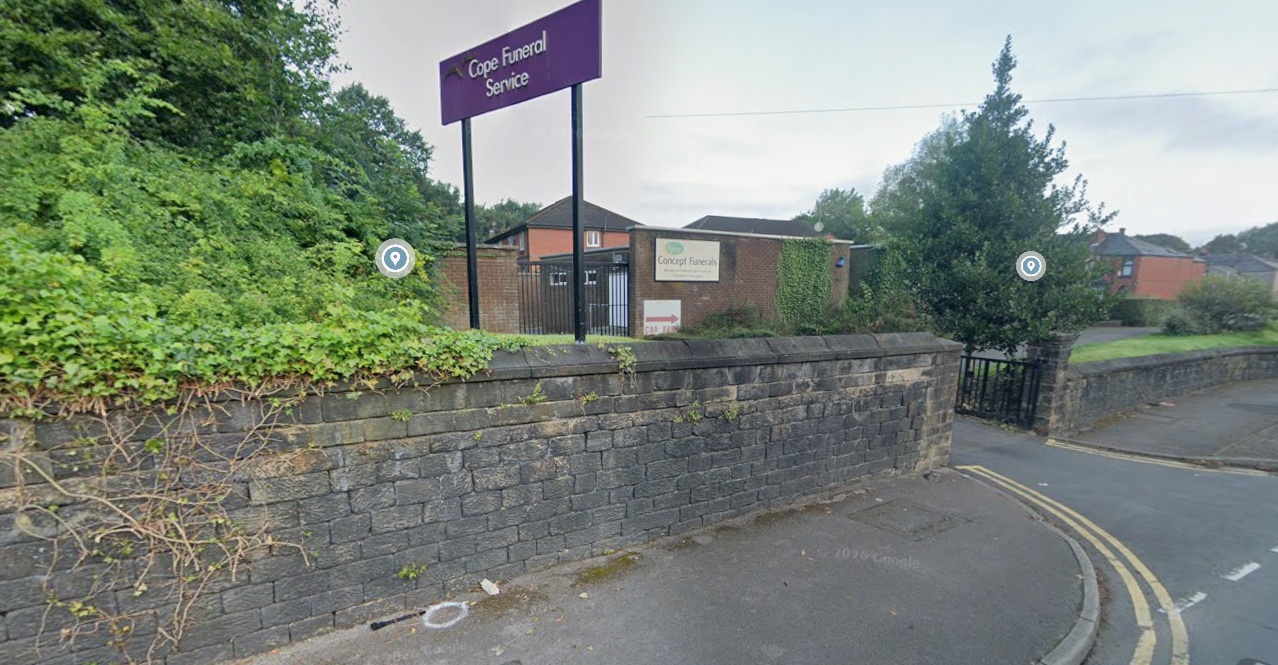
A plan to replace a Rochdale funeral home with 28 “cosy” apartments, each roughly the emotional and spatial equivalent of a well-upholstered casket, has been refused after planners concluded the scheme was “overbearing”, “unsympathetic”, and, crucially, “a bit much even for Rochdale.”
Reporting from down the M62, the proposal by Cope Funeral Services Ltd promised to transform the Manchester Road site into a trio of modern blocks where residents could enjoy all the comforts of contemporary living, provided they didn’t require the ability to fully extend their legs or experience joy.
Initial plans featured a single three-storey block with a central atrium, concierge, staff facilities, and a gym, presumably for those wishing to practise lying down more efficiently. Revised plans expanded the vision into three separate blocks, increasing both the number of walls and the opportunities to feel quietly enclosed.
Despite these changes, council planners remained unconvinced, noting persistent concerns around “massing” and “scale”, which insiders later clarified as “they’re massive, and there’s a lot of them.”
A planning officer’s report outlined fears that the development would dominate the street scene, loom over neighbouring properties, and create living conditions best described as “pre-interment adjacent.” Particular attention was given to the flats’ failure to meet national space standards, with some units rumoured to offer a bold new interpretation of “open-plan living” in which the bed, kitchen, and existential dread occupy the same square metre.
Residents of nearby properties expressed relief at the refusal. “I’ve got nothing against flats,” said one neighbour, peering out from behind a net curtain, “but I’d rather not live next door to what looks like a stack of upright coffins with Wi-Fi.”
The council also raised concerns about privacy, noting that ground-floor flats lacked defensible space, meaning occupants could be observed at all times by passers-by, delivery drivers, and anyone with a mild interest in human storage solutions.
In a supporting statement, Summit Planning Associates insisted the scheme represented “high-quality design” and “efficient use of land,” which critics interpreted as developer shorthand for “we’ve measured everything very carefully and still decided to ignore it.”
Planners, however, suggested more appropriate alternatives, including two-storey terraces, maisonettes, or “well-proportioned apartments”, a radical concept involving rooms large enough to contain both furniture and hope.
Further issues included a lack of ecological data, insufficient drainage strategy, and failure to meet energy and carbon targets, raising the possibility that future residents would be both cramped and damp, effectively recreating the full funeral experience from the comfort of their own home.
At press time, developers were said to be reviewing feedback and considering a revised proposal featuring “slightly wider coffins” and a communal area where residents can gather to reminisce about ceilings.
Council officials confirmed they remain open to redevelopment of the site, provided any future plans are “less oppressive, less mausoleum-adjacent, and ideally somewhere people might actually want to live before they die.”